
The Drama Triangle: Spot it out there and in here
Last night I was able to witness a large group of people in conflict. They were spinning around on the Drama Triangle. I hitched a ride for a bit, too!
The scene: The monthly neighborhood association meeting
“What are they thinking building that there? What’s this going to do to traffic? (Villian)
“It’s just too hard to schedule another meeting during the summer.” (Victim)
“This is a whole lot of drama, but whatever. Shall we move on?” (Rapid fire jump from Villain to Victim to Hero!)
“Holy cow these people are uptight. Such amazing drama! I’ll just watch for another 5, maybe 15 minutes" (me as Villain and Hero)
And there I spotted it in myself: The allure of focusing on other people’s drama! It’s so easy to take my eye off of my personal responsibility when there is a drama to focus on. I suspend my discomfort (Hero) by turning to distractions: Be it binging Netflix, social media, other people’s problems.
The Drama Triangle Within Us
When we’re in conflict with ourselves, our internal dialogue drops us onto the Drama Triangle. We disempower ourselves by being at the effect of life or circumstances (Victim), placing blame on ourselves or others (Villain), and finding temporary relief with distractions, escapism, or rescuing (Hero).
“I’m never going to… (get it, overcome it, succeed at it, etc.) (Victim)
“There is not enough” (Victim)
“I’m right, they’re wrong” (Villain)
“I’m not doing enough.” (Villain toward self)
“I’ll figure it out” (Hero)
“I’m OUT OF HERE!” (Hero)
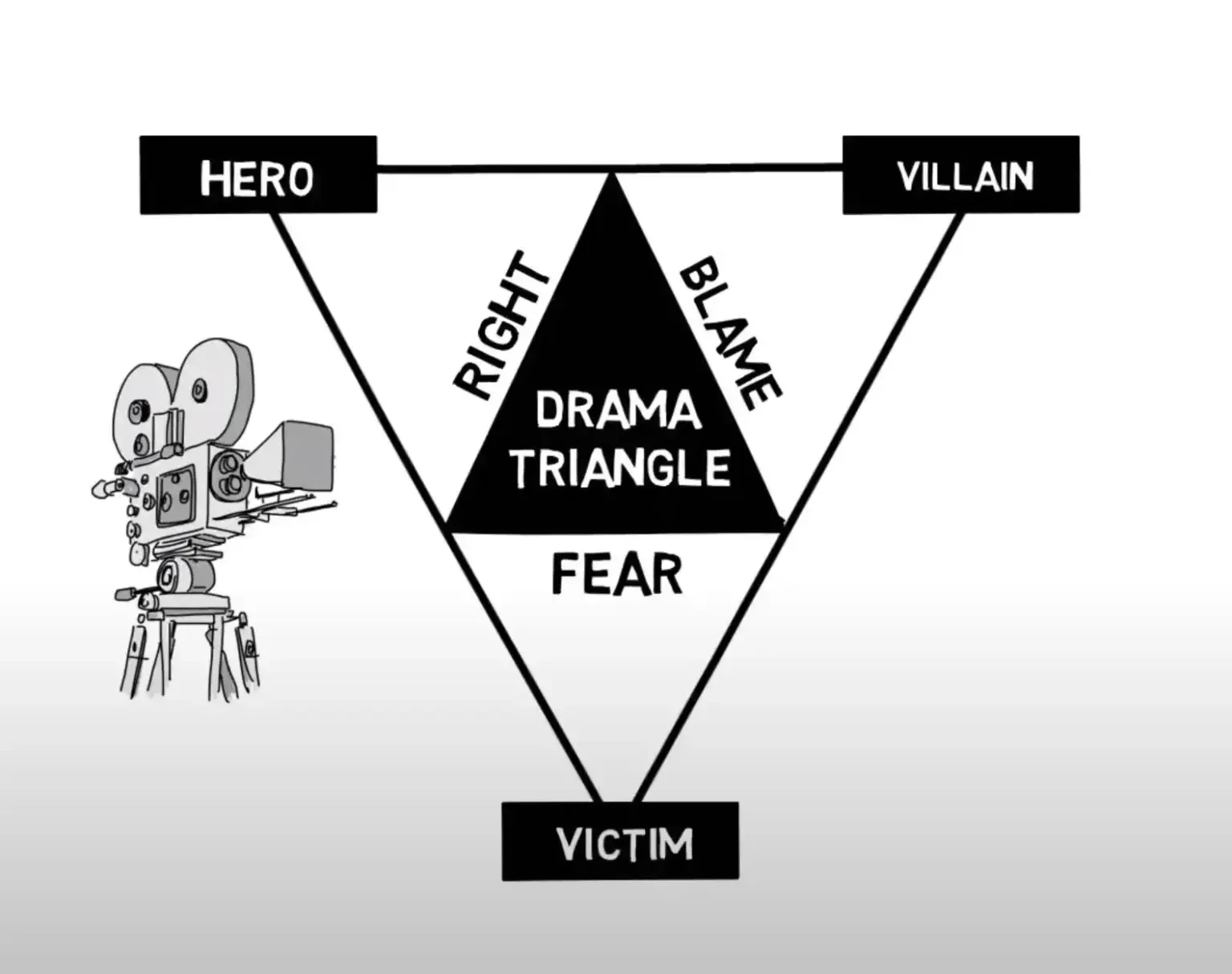
Psychiatrist Dr. Stephen Karpman created the Drama Triangle concept as a way to illustrate the repeating patterns of conflict in relationships.
The Victim is at the effect of things: other people, circumstances, limiting beliefs. Driven by fear.
The Persecutor (or Villian) places blame on others or ourselves
The Rescuer (or Hero) seeks temporary relief from discomfort. Seeks to be right.
The scenarios are endless and we all do it. The important first step is the act of noticing when we’re on the triangle. Once we see it for a deeply worn groove in our behavior (In yoga we call it samskaras) it can actually be quite funny.
“There I go, jumping into the victim position! Har!”
(OK, it takes time and tons of self-compassion to get there. Start small and imperfectly. This is where coaching can be transformative. Make a date to learn more about coaching with me!)
The act of noticing brings us to the present moment - even if only for a few seconds. It’s impossible to be truly present and still be on the Drama Triangle. From awareness and presence comes choice. That is the moment you can decide what you want and how to respond.
For example, by asking:
“Is this serving me?” or “How is this hindering me?”
“How can I take responsibility for…?”
“What can I learn from this?”
It’s these kinds of questions that facilitate a shift from victimhood to agency, from villainizing to appreciation, from hero to radical responsibility. It’s a lifelong practice and you can start today. Are you willing to start? Let’s talk!
Inspired by and sourced from the work of Dr. Stephen Karpman, The Conscious Leadership Group, and Dr. Kathlyn Hendricks, PhD at The Hendricks Institute. Drama Triangle Image courtesy of The Conscious Leadership Group.